DEV CHRONICLE: THE MAUSOLEUM
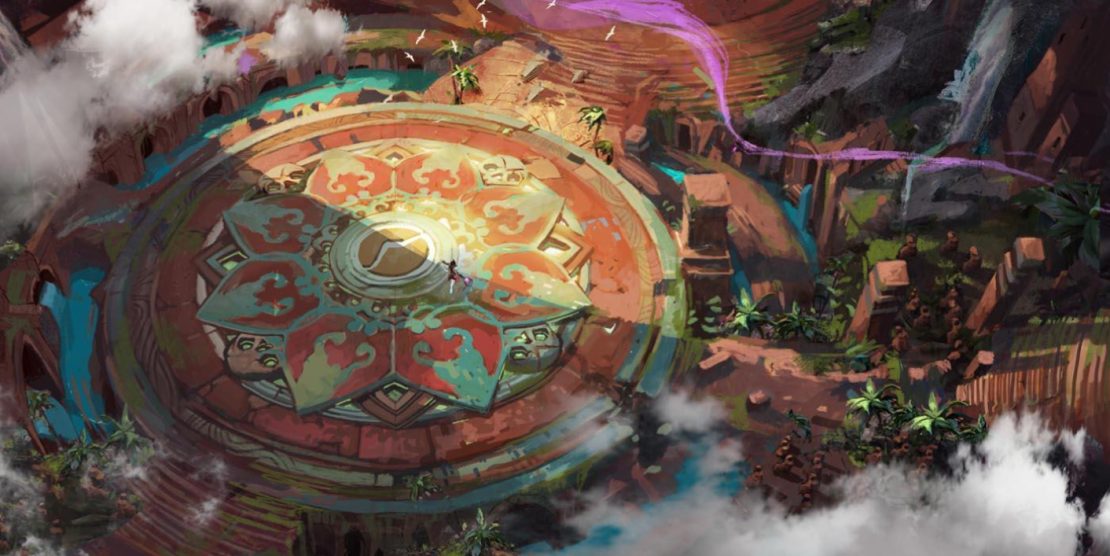
If you’re wondering where the Astral Monk draws her extraordinary powers from, the answer can be summed up in three words: the Gate of Varani. A sacred place in Ashkenon, the site of a thousand battles, which also holds a special place in the development of Spellcasters Chronicles.
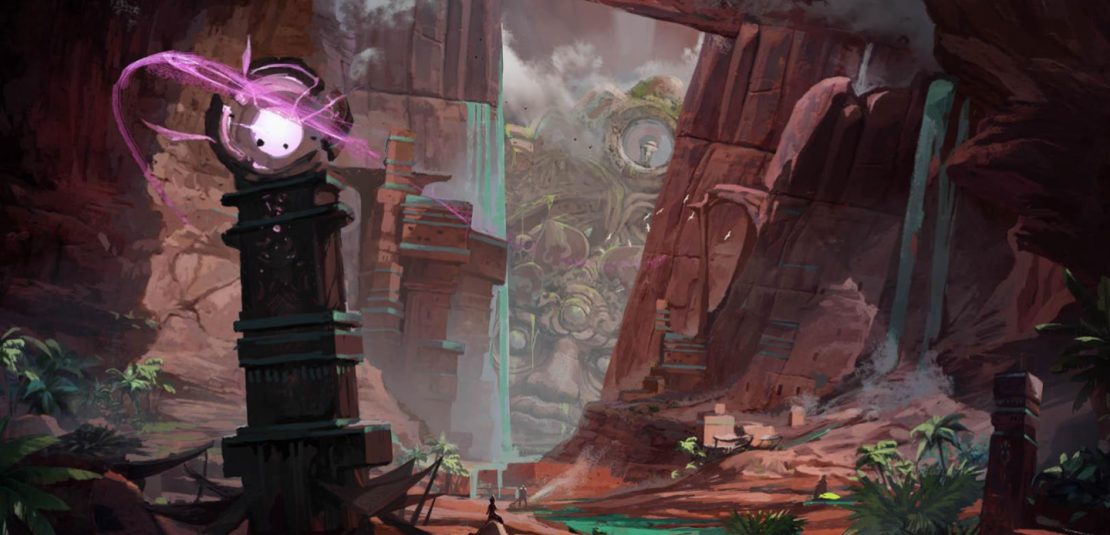
We must go back many generations to understand the origin of the Mausoleum, the birthplace of the Order of the Astral Monks. It all began in the heart of the Kingdom of Alaya, where an enigmatic sealed structure of unknown origin was discovered: the Gate of Varani. The first inhabitants of Alaya understood that this gate was in fact a barrier between our physical world and a dimension of limitless energy and unfathomable horrors: the Astral Domain. The Order was founded on the idea of crossing this barrier to contain the threat, relying on warriors born with the Gift of controlling the Source. Those who returned were forever altered in body and mind, transformed by the astral forces they had endured, and bound to guard the Gate for the rest of their lives. The Mausoleum was erected to honor these generations of monks who sacrificed everything to protect Alaya.
Asked about the creation process behind this arena, game director Gregorie Diaconu immediately emphasizes a key point: “This is the first arena we fully developed for Spellcasters Chronicles, and the one we showcased at TwitchCon 2025, when the game was revealed to players! It was designed as our reference arena and allowed us to finalize our gameplay loop.” The Mausoleum therefore contains the main hallmarks of the Ashkenon world: significant verticality to fully leverage the Spellcasters’ flight mechanics, semi-open pathways to enhance strategy, environmental elements that interact with certain infusions, and a strong aesthetic blending classical mythology with real-world inspirations to create the game’s signature style. “The Thread is visible in the sky,” Gregorie explains, “it’s there to remind players of its fundamental role in the life of Ashkenon.”
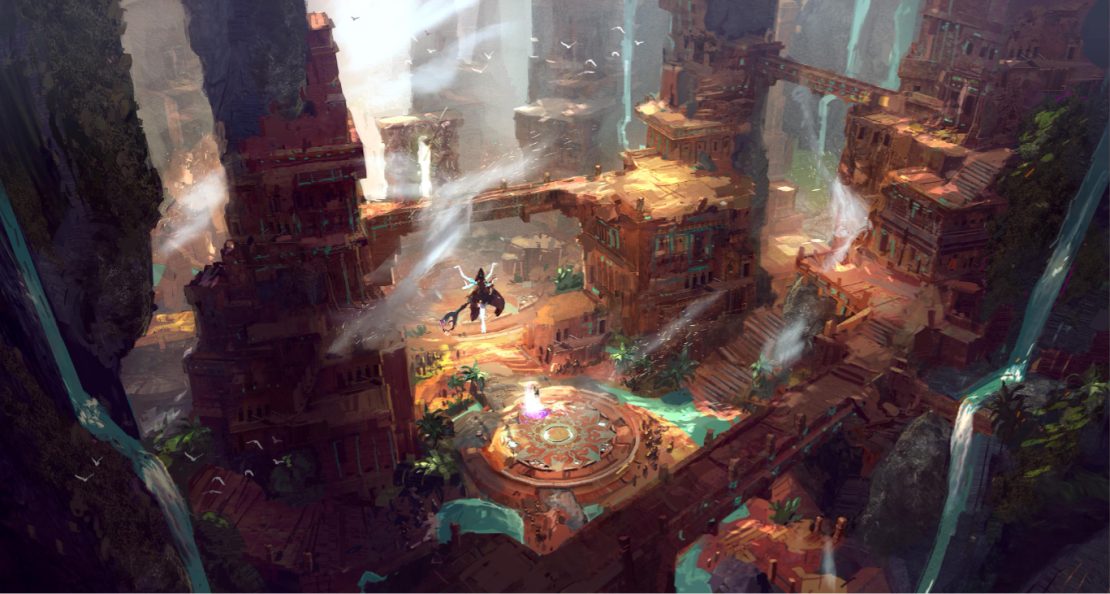
Aesthetics are of course central, as explained by Ronan Berlese, Art Director of Spellcasters Chronicles, who details the creative journey behind this spiritual location: “This arena draws on mystical inspirations—it’s the idea of a temple lost in the middle of nowhere. I was inspired by cenotes, these natural sinkholes filled with water, used by ancient civilizations as places of worship where relics and bones were thrown. When designing this arena, I started from a closed, solemn place, but I didn’t want it to feel gloomy, even though it deals with the opposition between demons and gods, the relationship with death, and titanic battles.”
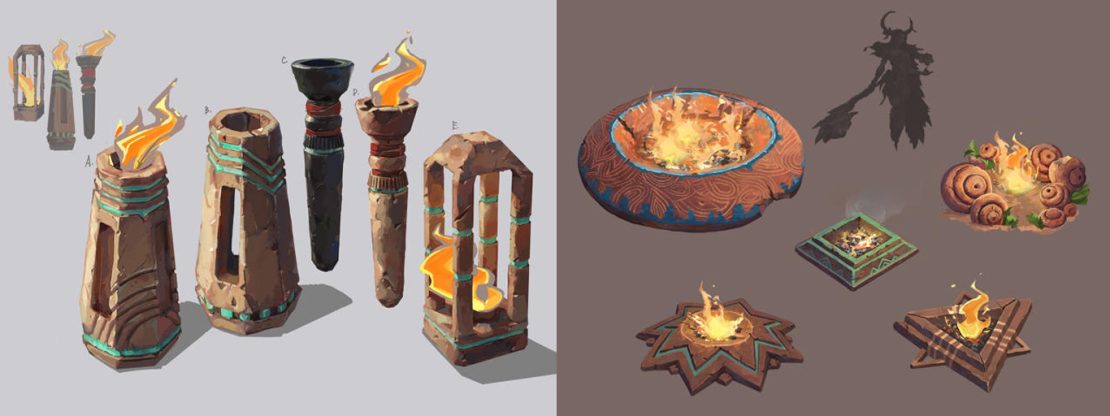
After further reflection, the team chose to move toward a more open structure, allowing for a freer artistic expression. “It became a canyon, so we could let light in and play with it,” Ronan explains. “We also added a lot of vegetation—there was a desire to fill the space with color and place gigantic pillars, evoking the site’s once-flourishing nature.”
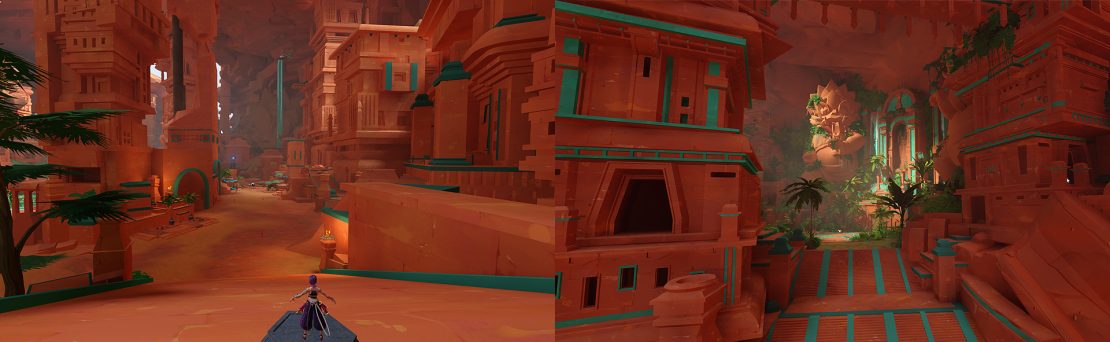
The Mausoleum reflects a dense, lush, even glorious past, now forgotten by most. It also gave Ronan and team the opportunity to add unique decorative elements while maintaining strong gameplay readability, even during intense action: “We played with the contrast between the canyon’s surface, raw, grainy, textured, and the statues leaning against it, which have a smoother, more refined aesthetic. It gives character while providing very clear volume cues. The same goes for the patterns on the ground and buildings, which echo the Astral Monk while also structuring the pillars, reinforcing the sense of a majestic place, but also giving spatial cues to players.”
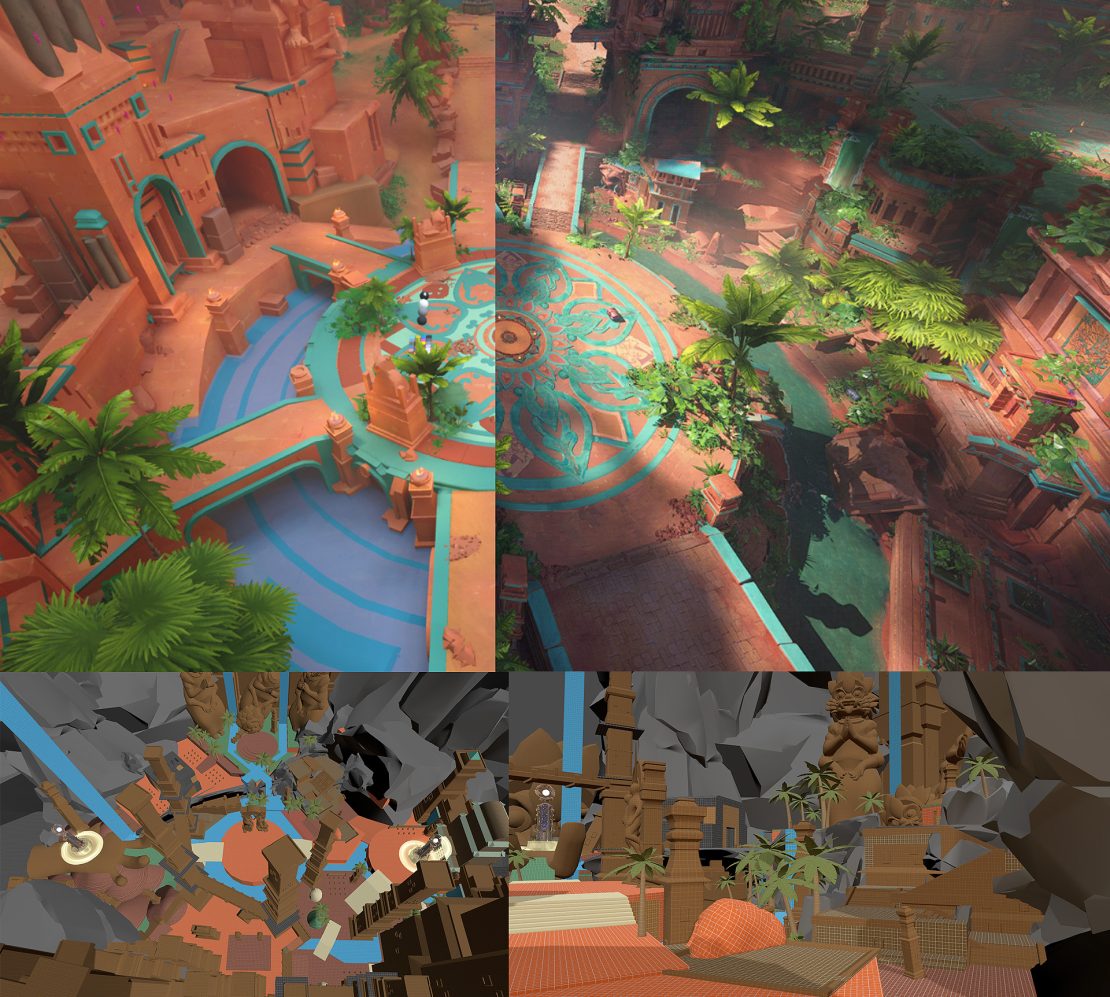
To merge gameplay intentions with the artistic vision at the heart of Spellcasters Chronicles, the Mausoleum truly served as an experimental laboratory. Within the environment art team, associate lead Paul Rouillard recalls the journey: “The real challenge was first understanding what we needed to do,” he admits with a smile. “We didn’t yet have all our in-house development tools or the full set of artistic assets, so naturally this arena took much longer to create than the ones that followed! It went through many iterations, prioritizing gameplay experience over certain creative ambitions, without ever losing sight of our strong artistic direction.” The same sentiment is echoed by his teammate Maxence Rey-Millet: “We had to think through every element, from the smallest rock to the largest cliff. To give you an idea, if you take the highest point of the canyon, at real scale it’s equivalent to 300 meters high, and there are 450 meters between the two opposing towers in the central lane.” These figures, compared to the size of Spellcasters and creatures, highlight the meticulous work carried out by the team to bring this first battlefield to life.
In the heat of battle, sightseeing in Ashkenon is not the main focus; this painstaking work ensures that Spellcasters, once past the initial visual impression, can navigate a 3D space instinctively. Paul illustrates this with the geometry of the lanes, which must clearly indicate accessible paths for summoned creatures while staying true to the overall aesthetic: “The Mausoleum allowed us to test every design idea to differentiate the ground from the rest of the environment; in cities, for example, we have sidewalks, we use them without thinking. In this arena, we played with ruins and vegetation, which fit the overall visual identity while enhancing readability during movement. Sometimes our artistic ambitions slow us down a bit, but once the lighting artists come in for the final touch, we’re always amazed at how they elevate our work!” A sentiment also shared by Maxence, pleased with the balance achieved: “I’m proud of the story we managed to tell with this arena, whether it’s the great gate, the dwellings, the jungle… We managed to include everything we wanted while keeping the practical aspect, which is essential for gameplay feel.”
Having left its mark on the history of Ashkenon in many ways, our beloved Mausoleum will surely deserve to be admired in a new light when our Spellcasters come to fight their next battle there. Or perhaps under a new night?